


Listen here:
Spotify Apple Podcasts YouTube Amazon
7 Homeschool Systems to Set Up Your School Year So It Runs Smoother
It’s 8 AM on the first day of school. The pencils are sharpened, the kids are sitting down with full hearts — and the website won’t load, one password is wrong, and a verification email is going to an account nobody remembers making. Sound familiar? The overwhelm most homeschool moms feel in the first weeks of the year usually isn’t a curriculum problem. It’s a systems problem.
In Part 2 of this two-part series on how to set up your homeschool year, homeschool expert Christy-Faith — author of Homeschool Rising and an education and parenting expert with over 20 years of experience — moves from mindset to the nuts and bolts. If Part 1 was about getting in the right headspace, this episode is about building your year with your hands: the seven systems Christy-Faith sets up every summer so her home runs itself by the time the school year starts, and every one of them is something she teaches her kids to run too.
System 1: Retrain the Chores Before the School Year Starts
Kids should have chores — the research is clear that contributing to the household is good for them — but chores have to be trained, and the worst possible time to roll out a brand-new chore system is the first week of school. Christy-Faith’s fix is a homeschool chore system built in summer: the kids train on their jobs before the year begins and keep the same chores all year long. By the time school starts, everyone knows exactly what they’re responsible for and when, the bickering is worked out, and the house essentially runs itself.
System 2: The Printed Homeschool Schedule Is a Security Blanket
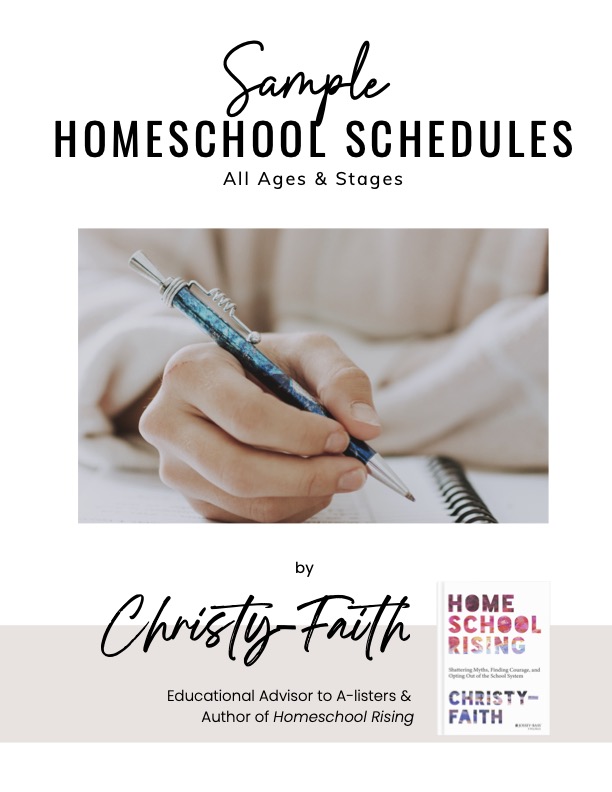
A printed visual schedule isn’t rigid — it’s a routine, and kids thrive on it. Christy-Faith prints a daily rhythm for each day of the week and gives each child their own copy to mark up. Predictability lowers kids’ stress; clinicians even name the exact tools that make it work — visual schedules, verbal previews, and transition warnings — which is a fancy way of describing what you already do when you tape the day to the fridge and talk it through. The game-changer in her house was putting herself on the schedule too, in her own column, so the kids can see exactly when they’ll get her and stop pining and nagging in the meantime.

System 3: Give Everything a Home (You Don’t Need a Schoolroom)
The benefit of homeschooling is that it isn’t school — so you don’t need a dedicated schoolroom, and your house doesn’t have to look like one. Christy-Faith homeschools all around the house: at the kitchen counter, in the living room, sometimes on the bathroom floor while she gets ready to film. The one homeschool organization rule that makes it work is that everything has a home. Each subject has a designated spot (math things live where there’s table space; casual subjects live by the couch), so kids aren’t constantly losing books and hunting for a pencil, and the house still stays tidy.

System 4: Set Up Your Tech and Passwords Before Day One
It’s unglamorous and it couldn’t matter more: before the first day, go into every portal, set the passwords, get the iPads and logins working, and assemble the binders — ideally alongside your kids, because setting it up is good for them to learn. Whatever you think will take fifteen minutes, schedule an hour. And for the moment a login inevitably breaks mid-day, have a ready activity your kids can pick up and step away from easily, so no one scatters to another room while you untangle a spinning wheel.
System 5: Teach the Plan for When Mom’s in the Weeds
The lie that quietly runs many homeschools is that a good mom is always available, always on call — but that only trains kids who can’t take a step without you. The fix is a simple, pre-taught plan: when mom has to take a call or figure something out, kids know to jump to their independent work — math facts, copy work, spelling, or whatever novel they’re reading — and knock it off their list. Christy-Faith adds one rule: stay close, so everyone can regroup quickly and move on. It’s a small script that keeps homeschool days running at a clip.
System 6: Do Your Own Homework First
The biggest thing Christy-Faith does to prepare has nothing to do with curriculum — it’s her own prep. You are the variable that makes a homeschool successful, far more than any curriculum, which is why she blocks off consistent time each summer to go subject by subject: watching the teacher videos, reading the teacher pages, and deciding how she’ll organize each course. The first time you crack open a lesson shouldn’t be the first day of school with a wide-eyed kid beside you. A little prep isn’t tedious busywork — it’s wisdom, and it changes how the whole year feels.
System 7: Layer Your Subjects in Slowly
Starting the year with every subject at once feels like a tidal wave — for you and your kids. Instead, layer subjects in: day one might be a single subject, a photo, and ice cream; the next day adds a read-aloud; and you hold there until the rhythm feels good before adding the next. It’s perfectly reasonable that six weeks in you haven’t touched every subject yet — in fact it’s often better. You’re not abandoning academic rigor; you’re being developmentally appropriate and protecting the relationship, which is what gives kids a peaceful, enriching year with a secure attachment to you.

⭐ New to Homeschooling? Start with Episode 101 — the New Homeschooler Series is the best place to begin.
Resources Mentioned
- Free Sample Homeschool Schedules — schedules by age and stage, Christy-Faith’s own included
- Homeschool Rising — Christy-Faith’s book, with a full chapter on deschooling
- The Christy-Faith List — find homeschool-friendly businesses and providers
- Thrive Homeschool Community — Christy-Faith’s membership community for homeschool moms
📚 Looking for more free resources? Find all of Christy-Faith’s freebies — including Curriculum Recommendations, Homeschool Style Finder, and Sample Schedules — at christy-faith.com/#freebies
Related Episodes
If this episode resonated with you, you’ll also want to listen to:
- How to Set Up Your Homeschool Year (Part 1) — the mindset half of this series: the quiet expectations that wreck your first weeks. Listen here
- You’re Not Going to Finish Your Homeschool Curriculum — Here’s What to Do — a simple framework for what to finish, park, or skip. Listen here
- How to Start Homeschooling (Part 1) — The Legal Stuff & Choosing Your Approach — where to begin if you’re brand new. Listen here
Frequently Asked Questions
How do I set up my homeschool year so it runs smoothly instead of starting in overwhelm?
According to Christy-Faith — homeschool expert, author of Homeschool Rising, and a 20-year education veteran — a smooth year comes from systems you build before day one, not from finding the perfect curriculum. In this episode she walks through seven: retraining chores in summer, printing a visual schedule, giving every subject a home, setting up tech and passwords early, teaching kids a plan for when you’re pulled away, doing your own curriculum prep, and layering subjects in slowly.
Do homeschoolers need a dedicated schoolroom?
No. Christy-Faith explains that the whole benefit of homeschooling is that it isn’t school, so your house doesn’t need to look like one. She homeschools all around the house and relies on one rule instead — everything has a home — giving each subject a designated storage spot so the house stays tidy without a separate room. If a dedicated room genuinely works for your family, that’s great too; it simply isn’t required.
Should homeschool kids follow a set schedule?
Christy-Faith recommends a printed routine rather than a rigid schedule. Kids feel more secure when they know what’s next, and clinicians have measured it — children on predictable routines carry lower stress hormones and recover from hard moments faster. She prints a daily rhythm each child can see, and even puts herself on it so kids know exactly when they’ll have her.
What do I do when I get pulled away in the middle of a homeschool lesson?
Teach the plan ahead of time, Christy-Faith says. When mom has to take a call or troubleshoot, kids should know to jump to independent work they can do without you — math facts, copy work, spelling, or reading — and then regroup when you’re free. Her one rule is that everyone stays close, so the day picks back up quickly instead of stalling out.
Is it okay if I don’t start all my subjects on the first day of school?
Absolutely — Christy-Faith actually recommends it. She layers subjects in slowly, starting with one and adding more only once the rhythm feels good, and notes it’s perfectly reasonable to still be adding subjects six weeks in. As she explains in the deschooling chapter of Homeschool Rising, an academically rigorous homeschool can still be developmentally appropriate — starting calm protects both your kids and your relationship with them.

About Christy-Faith
Christy-Faith is a homeschool expert, author, speaker, and the host of The Christy-Faith Show — the podcast for homeschool moms who take their craft seriously. With over 20 years of experience in education, a master’s degree, and a background founding and directing one of the country’s top private learning centers, Christy-Faith has advised everyone from everyday families to A-list celebrities and billionaires on their children’s education. She is the author of Homeschool Rising: Shattering Myths, Finding Courage, and Opting Out of the School System, the founder of the Thrive Homeschool Community, and the creator of the Christy-Faith List — a free directory of homeschool-friendly businesses and providers. A homeschool mom of four, she reaches over 400,000 followers across social media and has built one of the largest and most trusted voices in the homeschool movement.
Listen to the full episode above, and if this was helpful, share it with a homeschool mom who needs to hear it.

