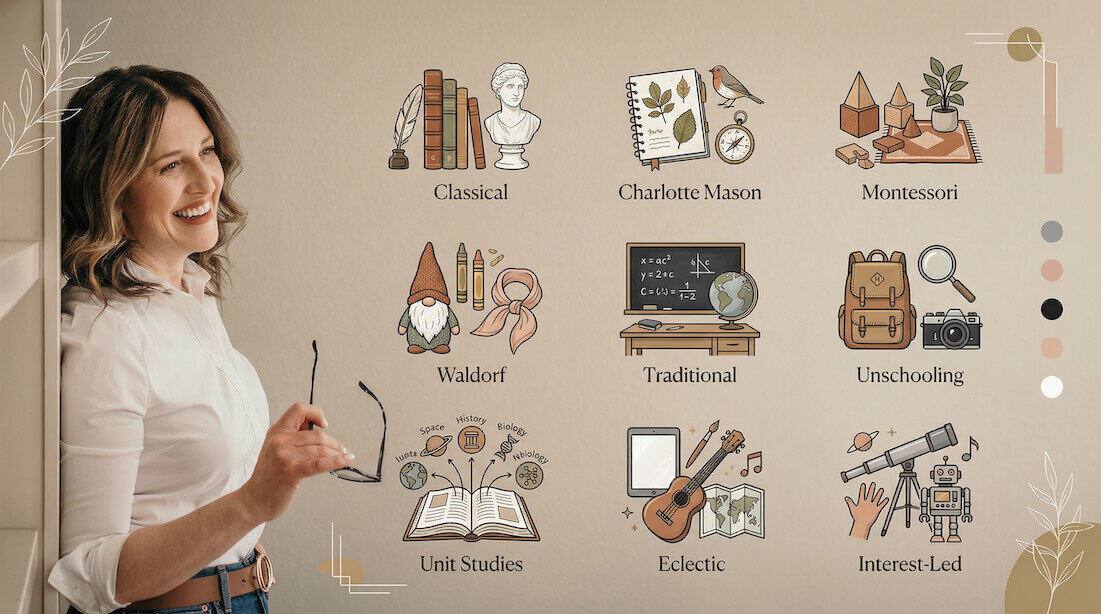
9 Homeschool Styles Explained
You knew you wanted to homeschool. But then you started Googling “homeschool methods” and suddenly you were drowning in words like trivium and living books and child-led learning — and you thought: wait, is there a quiz for this?
There is. I made you one.
But before you take it, I want you to actually understand what you’re choosing between — because picking a homeschool style without knowing what each one really feels like is like buying a house from a floor plan. The details matter.
I’ve been in education for over 20 years. I’ve taught in traditional schools. I’ve homeschooled my own kids. I wrote Homeschool Rising. And in all that time, I’ve identified 9 distinct homeschool styles that families actually use — not just the five you find on every other blog.
This guide covers all 9. Then at the bottom, a free 5-minute quiz tells you which one fits your family’s personality, your teaching style, and your real life.
Why finding your homeschool style changes everything
Here’s what I see happen all the time: a mom picks a curriculum that looks beautiful on Instagram. She spends a lot of money on it. Three months in, she’s burned out, her kids are frustrated, and she’s convinced she’s failing at homeschooling.
She’s not failing. She just picked someone else’s style.
Your homeschool style is the foundation everything else gets built on. It determines what curriculum will actually work for you, how your days are structured, whether your kids thrive or resist, and — honestly — whether you enjoy this or dread it.
There’s no right answer. There’s only the right answer for your family. The 9 styles below cover a real range — from highly structured to completely child-led, from literature-heavy to hands-on.
The 9 Homeschool Styles — What They Really Are
Classical Homeschooling
Classical homeschooling is one of the oldest educational frameworks in existence — it was the model used to educate philosophers, statesmen, and scientists for centuries. It’s built around the Trivium: Grammar (ages 4–9, focused on memorization and foundational knowledge), Logic (ages 9–12, focused on reasoning and critical thinking), and Rhetoric (ages 12–17, focused on communication and persuasive expression).
Classical homeschooling tends to be rigorous, literature-rich, and deeply sequential. Kids may study Latin, formal logic, and great books alongside history, science, and math.
Charlotte Mason
Charlotte Mason was a British educator in the late 1800s who believed children are not empty vessels to be filled — they are whole persons who learn best through living experiences, great literature, and the natural world.
Charlotte Mason homeschooling centers on “living books” (richly written, narrative-style books rather than dry textbooks), nature study, short focused lessons, narration (where children retell what they’ve learned instead of taking tests), and habit formation.
Traditional / School-at-Home
This is probably the first image that comes to mind when someone says “homeschool” — kids at the kitchen table, textbooks open, following a structured curriculum. Traditional homeschooling mirrors what most of us experienced in school: separate subjects, workbooks, grades, and lesson plans.
It’s often the starting point for new homeschool families because it feels familiar and provides clear structure.
Unschooling
Unschooling is child-led learning in its purest form. There is no formal curriculum, no assigned lessons, and no standardized schedule. Instead, children learn through living — pursuing their interests, asking questions, and following curiosity wherever it leads. Parents act as facilitators, providing resources and support rather than directing instruction.
Eclectic Homeschooling
Eclectic is the most common approach among experienced homeschoolers — because it’s built from honest observation of what actually works for your specific family. Eclectic homeschoolers pull from multiple styles and curricula, combining them deliberately to create something custom.
You might use a structured math curriculum, Charlotte Mason for language arts, and a unit study approach for history. That’s eclectic — and it’s not cheating.
Unit Studies
Unit studies take a theme or topic and weave all subjects through it. If you’re studying Ancient Egypt, you’re learning history, geography, science, literature, art, and math — all connected to that one topic. It creates natural integration and often lights up kids who struggle to see the point of isolated subjects.
Montessori
The Montessori method was developed by Dr. Maria Montessori in the early 1900s. It emphasizes hands-on, self-directed learning in a prepared environment. Children choose their work from available materials, move at their own pace, and often learn across age levels rather than in strict grade groupings.
In a homeschool context, Montessori looks like carefully curated materials, a calm learning environment, and a parent who observes and guides rather than instructs.
Waldorf
Waldorf education focuses on educating the whole child — mind, body, and spirit. It’s deeply developmental, meaning what’s taught is tied closely to a child’s age and stage of growth. The early years emphasize imagination, play, and the arts. Academics are introduced more gradually than in most other approaches.
Waldorf homeschooling often incorporates seasonal rhythms, artistic expression (painting, music, and handwork), and storytelling as a primary teaching method.
Interest-Led Learning
Interest-led learning sits in its own category — part unschooling, part eclectic, fully child-centered. The premise is that children learn most deeply when they’re learning about things that genuinely captivate them. Parents observe what their kids are drawn to and build learning around those passions and interests.
This isn’t about letting kids do whatever they want. It’s about recognizing that a child who is passionately interested in something will go further, faster, and more joyfully than a child doing assigned work.
How to figure out which homeschool style is actually right for you
Most homeschool content tells you to figure out your child’s learning style first. I’m going to push back on that.
Because here’s the reality: the best homeschool style is the one you’ll actually sustain. A Charlotte Mason homeschool that you hate will not serve your kids well, no matter how beautiful it looks on paper.
Ask yourself honestly:
- How do I like to learn? Do I like structure and clear plans, or do I prefer to follow curiosity?
- What were my own school experiences like — and what do I want to preserve or escape from them?
- What do I want my kids to remember about their childhood education — not just what they learned, but how it felt?
- What are my real constraints — time, energy, budget, number of kids?
Once you’ve answered those honestly, you’re ready to match yourself to a style. That’s exactly what the quiz below is designed to help you do.
Find your homeschool style right now

Thousands of moms have taken the 5-Minute Homeschool Style Finder and finally had the clarity they were looking for. It takes five minutes and gives you a real answer — not just a vague “you might be eclectic!”
Frequently asked questions about homeschool styles
The 9 homeschool styles are: Classical, Charlotte Mason, Traditional (School-at-Home), Unschooling, Eclectic, Unit Studies, Montessori, Waldorf, and Interest-Led Learning. Most families start with one style as a foundation and adapt over time — many eventually become eclectic homeschoolers who blend elements from several approaches.
Eclectic homeschooling is consistently the most common approach among experienced homeschoolers. Most families don’t fit neatly into a single style — they borrow what works from several methods and leave the rest. For families just starting out, Traditional/School-at-Home is often the entry point because it feels familiar.
Both are literature-rich approaches that value great ideas and deep learning. Classical homeschooling is more structured and sequential, organized around the Trivium (Grammar, Logic, Rhetoric stages). Charlotte Mason emphasizes nature, living books, short lessons, and narration — it’s more relational and less systematically stage-based. Many families use elements of both, particularly in the early years.
Absolutely — and most experienced homeschoolers do. Mixing styles intentionally is called eclectic homeschooling and is the most widely used approach. The key word is intentionally. Borrowing what works from several methods because you’ve thought it through is very different from constantly switching curricula because nothing feels right. Use the quiz to find your primary style first, then adapt from there.
Start with yourself, not your child. Ask: How do I like to learn? Do I want a lot of structure or flexibility? What’s my budget, and how much time do I realistically have? Then take the free 5-Minute Homeschool Style Finder quiz — it’s designed specifically to help new homeschool families find a starting point. Remember: your first style doesn’t have to be your forever style.
Eclectic homeschooling means you deliberately combine elements from multiple homeschool styles and curricula rather than following one approach exclusively. It’s the most flexible style and the most commonly used among families who’ve been homeschooling for a few years. It requires the most discernment — without a guiding vision, it can become reactive curriculum-hopping rather than intentional design.
For some families, it clicks in the first year. For others, it takes two or three years of trial and adaptation. The 5-Minute Homeschool Style Finder quiz gives you a starting point, but finding your style is also a process of learning — learning what lights your kids up, what you can sustain, and what kind of homeschool you actually want to live inside every day. The goal isn’t perfection. The goal is a homeschool that grows with your family.
Knowing your style is just the beginning.
The overwhelm you feel right now — that’s what happens when you’re trying to make a big decision without a framework. The 9 homeschool styles give you that framework. The quiz gives you a place to start.
But knowing your style is just the beginning. The deeper question is: what do you do with that information? Inside the Thrive Homeschool Community, I teach a full masterclass on all 9 styles — the philosophy behind each one, the books I recommend for parents who want to go deeper, and my top curriculum picks for each approach. It’s the only place where you can get that kind of comprehensive, experience-backed guidance on all 9 in one place.